
Leigh McLean's husband Colin loved the gym and was always in great shape – until multiple sclerosis changed his life.
Colin, 57, was diagnosed more than ten years ago, but since 2020 his condition has deteriorated significantly. He went from someone who could work and drive to being permanently in a wheelchair and needing care four times a day.
His wife Leigh told the BBC she has found an unexpected way to cope with her demanding role as a carer – one that has brought them even closer: fitness racing.
HYROX, an indoor fitness race in which thousands of people take on a series of challenges, has grown dramatically in popularity since it started in Germany in 2017.
Leigh, 50, says training for a specific race helps her stay positive, and her husband benefits from it too:
“When he hears I'm doing a race, he gets interested and it gives us something to talk about. He asks how I'm training and what I've been doing. He can be part of it and support me. It would feel disrespectful to sit at home on my backside when I have full mobility. I don't see why I can't achieve this.”
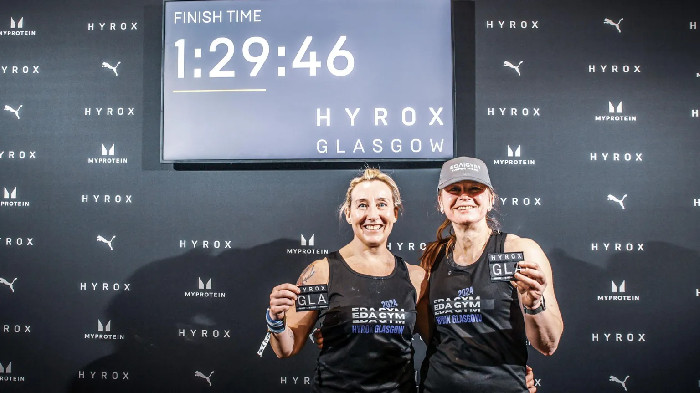
HYROX races run all year round in halls around the world. The course is a tough circuit of eight strength stations, with a one-kilometre run before each one.
In March this year Leigh lined up at the SEC in Glasgow and, together with her friend Wiki, finished fifth in the women's doubles in her age group.
The ballot for next year has just opened and Leigh has already secured tickets. “We're starting to plan our training, because there are only three months to go until the race,” she said.
Part of the experience is thousands of spectators cheering the athletes on, but because of his illness Colin can't be there in person. Even so, Leigh says he is happy and proud of what she achieves: “He's pleased when I accomplish something. He likes telling his friends about it.”
Colin acknowledges how important exercise is for Leigh: “She's my carer, so I support her fully in everything. I feel it helps us both – physically and mentally.”
When a friend first suggested the race, she hesitated. “I thought it wasn't for me. The same doubts most people have. As you get older you don't push yourself to extremes as much. You're afraid of failing or not managing it.” In the end she found the courage and signed up.
Athletes can also enter as a pair and split the work at the stations, but each of them runs every kilometre. One of the stations is the farmers carry – 200 metres with heavy weights in each hand. Others include pushing and pulling a loaded sled for 50 metres, 100 metres of sandbag lunges and 100 wall balls with a heavy medicine ball.
Leigh says strength training also has a practical benefit when caring for Colin: “When you have a disabled husband at home, there's a lot of physical work. He can't sit up in bed or lift his legs on his own – I have to pull him up. I'm only 155 cm tall and it's physically very demanding. If my back started hurting, we'd be in trouble.”
Exercise, she says, lets her switch off from day-to-day caring for a while: “When I focus on training, I can sort things out in my head and I'm not as stressed or sad. It helps me cope with everything – like fuel that keeps me going.”
Around 175,000 athletes took part in HYROX races worldwide last year, and this year it could be as many as 425,000. The races are so popular in the UK that tickets are sold by ballot. The Glasgow race runs for four days, from 13 to 16 March, at the SEC – the biggest event ever held in Scotland.
Leigh and Wiki already have their places secured – and they can't wait to start preparing.
Source: BBC News. Republished and translated as inspiration from the world of HYROX.